
Native Plants Offer Many Benefits To Maryland Gardens
This is the second part of a two part post. The first part was Native Plants To Be Thankful For In Your Landscape. This post was written by guest blogger Toni Bailey, owner and Landscape Architect of Gracefully Green LLC. Toni specializes in sustainable landscaping.
You wouldn’t think that writing a short piece about native plants, which populate 98% of my plant recommendations, would be hard, right? After all, I spend hours up close and personal with these critical players of our ecosystem, in gardens, in nurseries, in the woods, and in books and lectures too.
But it’s actually quite a challenge, because due to space, time, and energy (mine) constraints, I have to choose which ones to highlight. My problem is that I like them all, for various reasons. But I’ll get the ball rolling with a few that stand out, at least to me, in the pantheon of our Maryland Piedmont plants.
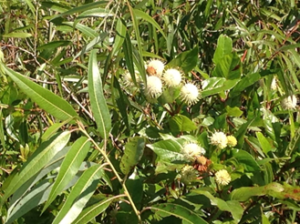
Buttonbush (Cephalanthus occidentalis) – This is such a fun plant, with its sputnik-like flowers. I’ve seen it growing in marshy areas along the C&O towpath outside Georgetown, a shady, wet habitat that it prefers. A deciduous shrub with glossy green leaves, it grows to a fairly large 6-12 foot size. For smaller gardens, there’s a cultivar called ‘Sugar Shack.’ Buttonbush attracts a variety of wildlife, including butterflies as well as water birds that eat the seeds.
Appalachian Sedge (Carex appalachica) – It’s good to have sedges in your repertoire; they’ll come to the rescue when other plants may let you down. Sedges are grass-like, low-growing groundcovers, and we have a number of them that are native to the Piedmont. Deer tend to leave them alone, which means sedges are always welcome in any garden in these parts. Like other sedges, Appalachian Sedge works well in shady, dry locations, such as under trees – a difficult location for many other plants, but fine for Appalachian Sedge.
Virginia Bluebells (Mertensia virginica) – We have those times when winter never seems to want to leave – the air is cold and windy, the ground frozen, and the changes you long for are taking their sweet time. And then, all of a sudden, when you walk out the door, there it is: your first Virginia bluebell. If you’re lucky, it might be in March but more likely it’s April. And if you’re like me, whenever it comes, your heart leaps. Even if it did nothing other than announce spring, the Virginia Bluebell has earned its keep. But it’s gorgeous too – visit the Manassas battlefield, pictured below, to see them in masses.
https://www.nps.gov/mana/learn/nature/bluebells.htm
Pagoda Dogwood (Cornus alternifolia) – Everybody knows about Flowering Dogwood (Cornus florida), one of our most stunning native flowering trees. But if you want to delve deeper into the dogwood gang, consider Pagoda Dogwood. Like Flowering Dogwood, it’s also a small woodland tree, but its branching structure is different, more horizontal, earning its name for bringing pagodas to mind. Pagoda Dogwoods, like Cornus florida, also have white flowers in spring and red fall color. They boast high wildlife value, producing a blue-black fruit that attracts grouse, pheasants, wild turkeys, and squirrels, and they are a larval host for the Spring Azure butterfly.
Goat’s Beard (Aruncus dioicus) – Here’s a perennial that we don’t see as often as we should. Goat’s Beard is a real standout in the shady garden, with striking white blooms and lush foliage. It’s on the large side, spreading to 6 feet, making it more like a shrub in size. Butterflies like it too; it’s a larval host for the Dusky Azure.
Indiangrass (Sorghastrum nutans) – No doubt you’ve seen this one, liked it, and wondered what it was. Now you know: Indiangrass. It begins the season growing lower to the ground, then by autumn has moved up to eight feet, sending out attractive tall flowers. Reliably showy, it turns shades of gold, deep orange, and purple in the fall. Small mammals and birds like the seeds, and it’s a larval host for the Pepper-and-Salt Skipper butterfly. I wasn’t sure anything could beat what a couple of our other native grasses, Little Bluestem and Switchgrass, could offer, but when I saw Indiangrass on a recent trip to New Mexico (where it is also native), I knew I had to start using it.
Hickory (Carya spp.) – Hickories will seem like just another tall deciduous tree most of the year, but in fall they become real fall color superstars, with a blast of golden yellow color that makes them easy to identify, even at a distance. What’s more, they produce a nut that is edible for humans as well as animals such as songbirds and small mammals, and butterflies seek it as a host for larvae. Hickories are canopy trees that provide critical services such as water and air filtration and shading, qualities we need much more of in our landscapes.
Related Posts:
Native Plants To Be Thankful For In Your Landscape
Remember, Allentuck Landscaping Co. is always here to help you design, install, construct and maintain you lawn and landscape. Give us a call!
Allentuck Landscaping Co. is Your Residential Landscape Company
Phone: 301-515-1900
Email: info@allentucklandscaping.com
Proudly serving Chevy Chase, Bethesda, Potomac, Darnestown, North Potomac, Rockville, Gaithersburg, Boyds, Germantown, Clarksburg, Ijamsville, Urbana and Frederick.